This week we visited the International Museum of Surgical Science (IMSS). Since the start of the semester, this had been the out of class trip that I was most excited about and it was definitely worth the weeks of anticipation. The museum is located in the Gold Coast district of Chicago on North Lake Shore Drive, a predominantly rich neighborhood. In addition to its location, the IMSS was not originally built to serve as a museum. The museum exists within a mansion that was built in 1917 and didn't become the IMSS until 1954. Upon exploring the museum a bit, it's easy to see that not much was done to the interior to make the building more suitable for exhibits. Instead, the pieces on display must fit around the original design of the mansion. Since the title of our class is 'Photography in Chicago Now,' it made sense that we spent the majority of our time upstairs at the 'Milestones in Medical Imaging' exhibit. The exhibit filled two rooms with the history of x-rays and medical diagnoses. The portion of the space that I particularly focused on was in the hallway entrance. Here, there was a collection of x-rays that were taken between 1900-1910 by a German immigrant who moved to Chicago named Emil Grubbe. Grubbe, an early pioneer of x-ray therapy and radiology, would analyze the s-rays to diagnose patients with diseases or other health problems. Although it is hard to say for sure because the prints were not labeled, it may be possible that some of the x-rays Grubbe took were for entertainment while others were used for medicinal purposes. A few of the x-rays featured men and women with their jewelry still on, which doesn't occur in the x-rays with obvious illnesses or problems. Overall, the collection was very interesting and diverse (one print featured a person with a bullet lodged in their upper leg and another showed a pair of a child's hands.) I wish that the prints had a definite story attached to each one were perhaps featured in a better part of the room, instead of the hallway. As with much of the exhibit, Grubbe's x-rays were also not very well preserved, but this did lend a certain charm and intimacy to the overall mood of the museum.
After our visit to the IMSS, we were assigned to watch a great documentary called
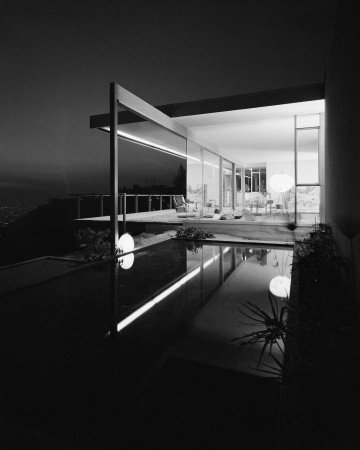
Visual Acoustics: The Modernism of Julius Schulman. Before watching the film, I had not heard Juilus Schulman's name, but had seen a few of his photographs and was familiar with a few of the buildings that became his subjects as an architectural photographer. As I watched the film, it was easy to become infatuated with Schulman's passion for his craft and appreciate the fresh perspective he brought to the trade. The trademark of his work was his use of one-point perspective to emphasize the clean lines of modernist architecture, mostly in his interior shots. He also payed special attention to the surrounding area of a building or home to show how it fit into its surroundings. As his career progressed, his photographs moved beyond being beautiful documentations of modern architecture, but he became an authority on what architects were promising and gave many a start to their lifelong careers. Until later in his life when his work was shown as artistic photographs and his portfolio was made into photography books, Schulman's photos were mostly printed in magazines about homes, architecture, etc. This progression in Schulman's career brought to mind an idea that was brought up during our trip a few weeks back to the Art Institute of Chicago: most photography was not seen as "art" until later in the 20th century. Towards the end of the movie, Schulman is doing a publicity appearance and a woman tells him that he's a "rock star." Although his work could not have existed if he had come along in another generation, it's a shame that his photographs were not given the widespread acclaim that they deserved until later in his life when they were viewed as "art." That's not to say that he went his whole life without any accolades for his work, because he was known as the top modern architecture photographer for decades, but I can't help but wonder what his career would have looked like if he had been coming up onto the scene now. Below are a few examples of his work for your viewing pleasure:




No comments:
Post a Comment